Journal of Dental Problems and Solutions
Granular Cell Ameloblastoma: A Case Report and Literature Review
Department of Oral and Maxillofacial Surgery, Sibar Institute of Dental Sciences, Guntur, India
Author and article information
Cite this as
Kattimani V, Sumanti J, Prasad LK (2015) Granular Cell Ameloblastoma: A Case Report and Literature Review. J Dent Probl Solut. 2015; 2(2): 31-33. Available from: 10.17352/2394-8418.000013
Copyright License
© 2015 Kattimani V, et al. This is an open-access article distributed under the terms of the Creative Commons Attribution License, which permits unrestricted use, distribution, and reproduction in any medium, provided the original author and source are credited.The purpose of this case report is to compare the clinical and histopathologic features of granular cell ameloblastoma with critical review on literature. Data with respect to the histologic types regarding tumor with higher recurrence rates are also investigated. Numerous cases of ameloblastoma have been reported in the literature. However, only a few articles discuss granular cell ameloblastoma and few closely examine their nature and pathogenesis. In this case report, we analyzed the clinical and histopathologic features of granular cell ameloblastoma.
Ameloblastoma (AB) is defined as a benign, but locally aggressive epithelial odontogenic neoplasm arising in the jaw and having close resemblance to the enamel organ epithelium [1]. Although the most common odontogenic neoplasm, it accounts for only 1% of all jaw tumors. They are slow-growing, locally invasive tumours that run a benign course in most cases [2-4]. They occur in three different clinicoradiographic situations which deserve separate consideration because of differing therapeutic considerations and prognosis [1,5-7]. These are: conventional solid or multicystic (about 86% of all cases); unicystic (about 13% of all cases); and peripheral (extraosseous; about 1% of all cases) [1,2,9,10]. It is well known that ameloblastoma can be radiologically unilocular or multilocular and that unilocular or multilocular ameloblastoma may be histologically unicystic or multicystic [10].
Sometimes, ameloblastomas present as soft tissue swellings occurring in the tooth-bearing areas of the maxilla or mandible without involvement of the underlying bone. This peripheral ameloblastoma should not be confused with intraosseous ameloblastomas that spread from within the jaw into the overlying gingiva [11]. In the past, these lesions have also been described as odontogenic gingival epithelial hamartoma [12]. For peripheral ameloblastoma simple excision will be sufficient treatment [13,14].
Granular cell ameloblastoma is a variant of ameloblastoma that histopathologically has numerous large eosinophilic granular cells. These granular cells are formed by transformation of lesional epithelial cells. Although originally considered to represent aging or degenerative changes in long standing lesions, this variant has been seen in young patients and in clinically aggressive tumors. When this granular cell change is extensive in an ameloblastoma, the designation of granular cell ameloblastoma is appropriate. The granular cells usually form the central mass of the epithelial tumor islands and cords. The periphery of the islands consists of non-granular tall columnar cells.
In granular cell ameloblastoma there is marked transformation of the cytoplasm, usually of stellate reticulum like cells, so that it takes a very coarse, granular eosinophilic appearance. Granular cell variety of ameloblastoma appears to be an aggressive lesion with a marked proclivity for recurrence. In addition, several cases of this type have been reported as metastasizing. The lesion have been shown to recur, particularly following inadequate surgical treatment [10].
Case Report
A female patient aged 34 yrs complains of swelling of left side gingiva in the region of canine and premolar since 1 yr. Which was smaller in size and gradually grown to present size, with difficulty in chewing as the growth is interfering in occlusion. On examination the sessile growth originated from left side of gingiva both lingually and buccally in relation to premolars. Which was approximately of 3×4 cm in size and superiorly above the occlusal plane and inferiorly the buccal vestibule. The lesion extends anteriorly from canine and posteriorly till mesial aspect of first molar. It was non tender and no lymphadenopathy felt. After routine blood investigations the patient posted for excisional biopsy. Under general anesthesia peripheral osteotomy performed and specimen sent for histopathology diagnosis.
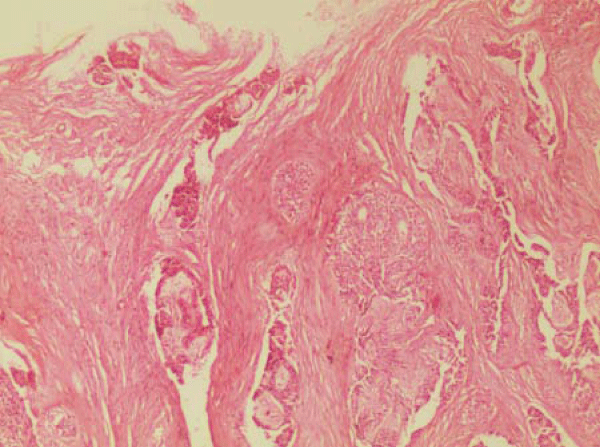
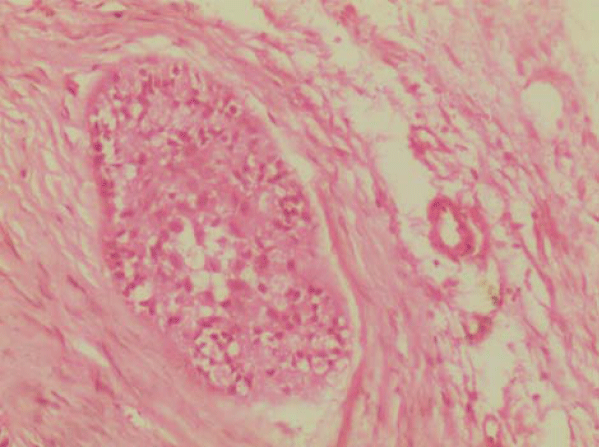
Histopathological report of excisional biopsy taken from right buccal vestibule in relation to 45 & 46 region revealed islands of ameloblastic epithelium in a fibrous connective tissue stroma. The centre of the island shows granular cells with eosinophilic granular cytoplasm and central nucleus. These features are suggestive of granular cell variant of ameloblastoma.
Discussion
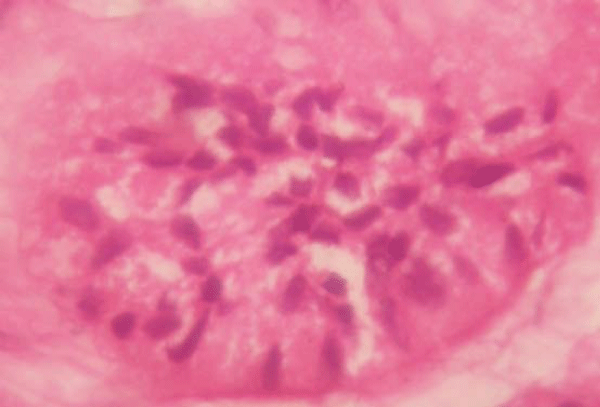
The granular cell ameloblastoma is characterized by the presence of large masses of granular cells located within the follicles (Figure 1). This occurs in 1% - 5% of cases [15,16]. The cells are large, round, or polyhedral, and densely packed with eosinophilic granules and frequently demonstrate well-defined borders but, in some instances, form a syncytium. The nuclei are generally pyknotic and eccentrically displaced (Figures 2 and 3). The cells replace all or part of the stellate reticulum and, quite often the peripheral cells as well [15,17]. The granular cells are periodic acid-Schiff-positive and diastase resistant [18]. In our case much similar histopathologic finding of granular cell variant seen clearly.
They are considered to be of ectodermal origin [19] and are apparently derived from odontogenic epithelium [15], the most likely source being elements of the enamel organ [20-24], specifically ameloblasts [20,27]. The significance of the granular cells has been a matter of conjecture. Several investigators have considered them to represent a degenerative alteration [23,25-28], an aging phenomenon [28], or an attempt to form enamel matrix precursor [29]. However, ultra structural and histochemical studies have disclosed that the granules are actually lysosomes [18,19,26,27,30,31]. The granular cells are periodic acid-Schiff-positive, diastase resistant [18]. They are also positive for antichymotrypsin, antitrypsin, and keratins [18,31-34], as well as acid phosphatase and various oxidative enzymes [35], but are negative for vimentin [18,34], S-100 protein and neuron specific enolase [31,34].
The aggressiveness of this has been correlated with an enhanced DNA synthesis [36,37] and can also be attributed to the similarity of behavioral features between the ameloblastoma and the dental lamina. Both have the inherent ability to invade connective tissue and the columns of proliferating cells of the dental lamina are highly reminiscent of the invasive extensions seen with the ameloblastoma. Consistent with this aggressiveness is the presence of carcinoembryonic antigen (CEA) within more mature cells that demonstrate squamous differentiation or within cystic spaces formed by tumor islands composed of these cells.
The surgical management of ameloblastoma remains controversial issue in oral and maxillofacial surgery because of the unique biological behavior of this disease as a slow growing locally invasive tumor with high recurrence [38,39]. Treatment of ameloblastoma should be based on an accurate history, careful clinical examination, routine radiographs, special imaging, and representative biopsy reviewed with an oral pathologist. Surgical options include segmental resection, en bloc resection, simple curettage, and excision with peripheral ostectomy [40]. Because of its nature of tumor we have done aggressive treatment. At the time of presentation our case finished 5 yrs of follow-up without any recurrences. Further patient has been instructed to have follow-up visits for every year for another two follow-ups. Patient is now considered for prosthetic rehabilitation with help of removable partial denture. In near feature we are planning for rehabilitation of the patient using implant supported prosthesis.
The literature indicates the cystic variant is biologically less aggressive and has a better response to enucleation or curettage than does the solid ameloblastoma [3,6,38,40,41]. Unicystic lesions are often enucleated or curetted before the true diagnosis is known, and the surgeon may be reluctant to recommend a more aggressive approach depending on nature of these lesions. In six studies of cystic ameloblastoma, the overall recurrence rate for all cases was 15%. Reported recurrence rates of solid ameloblastomas treated by curettage range from 55% to 90% [10].
Conclusion
The location of the lesion, the extent of expansion, the presence of sound uninvolved cortical bone, and, to some degree the histologic nature of the tumor are all factors that must be considered when designing therapy [8]. Successful treatment is the one that renders an acceptable prognosis, causing minimal disfigurement and is based on the behavior and potential of the tumor. Because of the late recurrence of the lesion, long- term follow-up is indicated in all patients. So here we presented case of granular cell ameloblastoma with successful treatment of 5 yr follow-up without any recurrence.
- Waldron CA (2002) Odontogenic cysts and tumors. In: Neville BW, Damm DD, Allen CM, Bouquot JE, editors. Oral and maxillofacial pathology. 2nd ed. Pennsylvania: Saunders; p 589-642.
- Sapp JP, Eversole LR, Wysocki GP (2004) Contemporary oral and maxillofacial pathology, 2nd edn. St Louis, MO: Mosby, p136-143.
- Laskaris G (2003) Color atlas of oral diseases, 3rd edn. Stuttgart, Germany: Thieme, 2003, p 410-411.
- Regezi JA, Sciubba JJ, Jordan RCK (2003) Oral pathology: clinical pathologic correlations, 4th edn. St Louis, MO: W.B. Saunders, p 267-274.
- Gardner DG, Shear M, Philipsen HP, Coleman (2005) Ameloblastomas. In: Barnes L, Eveson JW, Reichart P, Sidransky D, editors. World health organization pathology and genetics. Head and neck tumors. 1st ed. Lyon, France: IARC Press; p 296-300.
- Reid-Nicholson M, Teague D, White B, Ramalingam P, Abdelsayed R (2009) Fine Needle Aspiration Findings in Malignant Ameloblastoma: A Case Report and Differential Diagnosis. Diagn Cytopathol 37: 586-591.
- Heikinheimo K1, Jee KJ, Niini T, Aalto Y, Happonen RP, et al. (2002) Gene expression profiling of ameloblastoma and human tooth germ by means of a cDNA microarray. J Dent Res 81: 525-530.
- Stephen A (2006) Sachs, surgical exision with peripheral osteotomy: a definitive, yet conservative, approach to the surgical management of ameloblastoma. J Oral Maxillofac Surg 64: 476-483.
- Nakamura N, Higuchi Y, Mitsuyasu T, Sandra F, Ohishi M (2002) Comparison of long term results between different approaches to ameloblastoma. Oral Surg 93: 13-20.
- Ogunsalu C, Daisley H, Henry K, Bedayse S, White K, et al. (2006) A New Radiological Classification for Ameloblastoma Based on Analysis of 19 Cases. West Indian Med J 55: 434-439.
- Philipsen HP, Reichart PA, Nikai H, Takata T, Kudo Y (2001) Peripheral ameloblastoma: biological profile based on 160 cases from the literature. Oral Oncol 37: 17-27.
- Williams TP (1993) Management of ameloblastoma: a changing perspective. J Oral Maxillofac Surg 51: 1064-1070.
- Gardner DG (1996) Some current concepts on the pathology of ameloblastomas. Oral Surg Oral Med Oral Pathol Oral Radiol Endod1 82: 660-669.
- Philipsen HP, Reichart PA (1998) Unicystic ameloblastoma. A review of 193 cases from the literature. Oral Oncol 34: 317-325.
- Hartman KS (1974) Granular cell ameloblastoma. Oral surg Oral Med Oral Pathol 38: 241-253.
- Waldron CA, El-Mofty SK (1987) A histopathologic study of 116 ameloblastomas with special reference to the desmoplastic variant. Oral Surg Oral Med Oral Pathol 63: 41-45.
- Buchncr A (1973) Granular-cell odontogenic cyst. Oral Surg Oral Med Oral Pathol 36: 707-712.
- Mirchandani R, Sciubba JJ, Mir R (1980) Granular cell lesions of the jaws and oral cavity: a clinicopathologic. Immunohistochemical, and ultrastructural study. J Oral Maxillofac Surg 47: 1248-1255.
- Navarrete AR, Smith M (1971) Ultrastructure of granular cell ameloblastoma. Cancer 27: 948-955.
- Gorlin RJ, Chaudhry AP, Pindborg JJ (1961) Odontogenic tumors: classification, histopathology. and clinical behavior in man and domesticated animals. Cancer 14: 73-101.
- Campbell JAH (1956) Adamantinoma containing tissue rcsembling granular cell myoblastoma. J Pathol Bacteriol 71: 45-49.
- Hodson JJ (1957) Observations on the origin and nature of the adamantinoma with specific reference to certain muco-epidermoid variations. Br J Plast Surg 10: 38-59.
- Mallik KCB (1957) An atypical adamantinoma with cells resembling granular cell myoblastoma. Arch Pathol 64: 158-161.
- McCallum HM, Capell DF (1957) Adamantinomas with grmulnr cells. J Pathol Bacteriol 74: 365-369.
- Aisenberg MS (1953) Histopathology of amekhiastonias. Oral Surg Oral Med Oral Pathol 6: l111-1128.
- Mori M (1970) Histochemical evaluatlon of enzymes in amcloblastic tumors-acanthomatous and granular cell ameloblastoma. J Oral Surg 28: 825-83l.
- Tandlcr B, Rossi EP (1977) Granular cell ameloblastoma: elcctron microscopic observations. J Oral Pathol 6: 401-412.
- Tsukada Y, de la Pava S, Pickron JW (1965) Granular cell ameloblastoma with metastasis to the lungs. Cancer 18: 916-925.
- Hoke HF, Harrelson AB. Granular cell ameloblastoma with metastases to the cervical vertebrae. Observations on the origin of the granular cells. Cancer 1967; 29:991-999.
- Nasu M, Takagi M, Yamamoto H (1984) Ultrastructural and histochemical studies of granular cell ameloblastoma. J Oral Pathol 13: 448-456.
- Slootweg PJ, deWilde PCM, Vooijs P, Ramaeters F (1983) Oral granular cell lesions. An immunohistochemical study with emphasis on intermediate-sized lilament proteins. Virchows Arch Pathol Anat 402: 35-45.
- DeWilde PCM, Slootweg PJ, Miiller H, Kant A, Moesker 0, et al. (1984) Ramaekers FCS. Immunocytochemical demonstration of intermediate filaments in a granular cell ameloblastoma. J Oral Pathol 13: 29-39.
- Stewart CM, Watson RE, Eversole LR, Fischlschwelger W, Leider A (1988) Oral granular cell tumors: a clinlcopathological and Immunocytochemical study. Oral Surg Oral Med Oral Pathol 65: 427-435.
- Regezi JA, Zarbo RJ, Courtney RM, Crissman JD (1989) Immunoreactivity of granular cell lcsions of skin mucosa And jaw. Cancer 64: 1455-1460.
- Chomette G, Auriul M, Vaillant JM (1984) Histoenzymological leatures of epithelial cells in epidermoid carcinomas of oral mucosa and in ameloblastomas of jaws. Pathol Biol 32: 995-1003.
- Main DMG (1970) Epithelial jaw cysts: a clinicopathological reappraisal. Br J Oral Surg 8: 114-125.
- Vedofte P, Dabelstecn E (1975) Blood group antigens A and B in ameloblastoma odontogenic keratocysts and non-keratinizing cysts. Scand J Dent Res 83: 96-102.
- Baden E, Moskow BS, Moskow R (1968) Odontogenic gingival epithelial hamartoma. J Oral Surg 26: 702-714.
- Feinberg SE, Steinberg B (1996) Surgical management of ameloblastoma: current status of literature. Oral Surg Oral Med Oral Pathol 81: 383-388.
- Garder DG, Pecak AMJ (1980) The treatment of ameloblastoma based on the pathologic and anatomical principles. Cancer 46: 2514-2519.
- Arora S, Mujhib A, Diwakar G, Amberker V. Granular cell ameloblastoma: A case report with a brief note on review of literature. Egyptian Journal of Ear, Nose, Throat and Allied Sciences 2014;15(3):267-269.



 Save to Mendeley
Article Alerts
Subscribe to our articles alerts and stay tuned.
 This work is licensed under a Creative Commons Attribution 4.0 International License.