Journal of Dental Problems and Solutions
Neonatal Teeth and Riga-Fede Disease
1University of Louisville, Department of Orthodontics, Pediatric Dentistry and Special Care, USA.
2University of Monterrey, Health Science Division, Monterrey, NL, Mexico
Author and article information
Cite this as
Martinez Menchaca HR, Silva GR (2016) Neonatal Teeth and Riga-Fede Disease. J Dent Probl Solut. 2016; 3(2): 30-30. Available from: 10.17352/2394-8418.000030
Copyright License
© 2016 Martinez Menchaca HR, et al. This is an open-access article distributed under the terms of the Creative Commons Attribution License, which permits unrestricted use, distribution, and reproduction in any medium, provided the original author and source are credited.A 3 week-old male presented with ulceration on the ventral surface of the tongue. His parents informed that the patient had poor nutrients intake due to pain caused by tongue ulcer. The intraoral exploration showed ulceration of 10 mm diameter enclosed with a white fibrinous layer, situated on the ventral area of the tongue and two crows of neonatal teeth located in the mandibular anterior region (Figure 1). The incisal edges of teeth were smoothened about 2 mm. During a one–month follow-up his tongue ulcer disappeared.
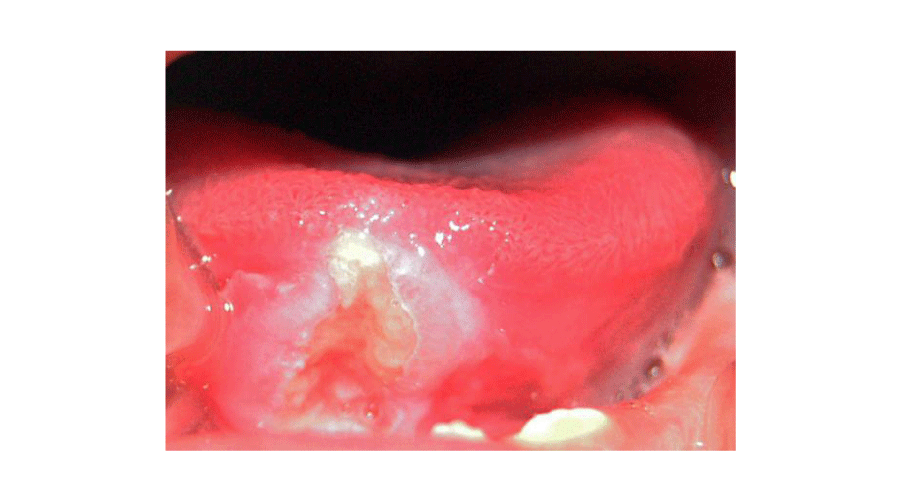
A 3 week-old male presented with ulceration on the ventral surface of the tongue. His parents informed that the patient had poor nutrients intake due to pain caused by tongue ulcer. The intraoral exploration showed ulceration of 10 mm diameter enclosed with a white fibrinous layer, situated on the ventral area of the tongue and two crows of neonatal teeth located in the mandibular anterior region (Figure 1). The incisal edges of teeth were smoothened about 2 mm. During a one–month follow-up his tongue ulcer disappeared.



 Save to Mendeley
Article Alerts
Subscribe to our articles alerts and stay tuned.
 This work is licensed under a Creative Commons Attribution 4.0 International License.