Archives of Otolaryngology and Rhinology
Treatment of Ankyloglosia with Coblation Assisted Surgery
Sakarya Akyazi State Hospital, ENT Clinic, Sakarya, Turkey
Author and article information
Cite this as
Sahin C (2016) Treatment of Ankyloglosia with Coblation Assisted Surgery. Arch Otolaryngol Rhinold. 2015; 2(1): 25-26. Available from: 10.17352/2455-1759.000017
Copyright License
© 2015 Sahin C. This is an open-access article distributed under the terms of the Creative Commons Attribution License, which permits unrestricted use, distribution, and reproduction in any medium, provided the original author and source are credited.Ankyloglossia is a disease characterized by difficulty in breast-feeding, limitation of tongue, andspeech disorders. Prevalence of the disease is %1-10 in the literature (1). Cold knife, Laser surgery,electro cautery methods are used in the surgical treatment of the disease. Coblation radiofrequency technology provides low temperature work with minimal damage to neighborhood tissues. We presenta 21 years old male with ankyloglossia treated by coblation surgery in the lights of the literature.
Ankyloglossia named also as hypertrophic lingual frenulum, tongue-tie in the literature. There is a fibrous band between base of tongue and tongue that prevents the movement of the tongue. Males are more often affected than females [1]. Breast feeding, speech problems and nutritional problems are associated with the disease because of functional problem of tongue.
Treatment of the disease is surgical treatment. Time of the surgery is controversial. Cold surgery, electro surgery, laser surgical methods are described in the literature [2-4].
Coblation surgery is a new technology. Coblation surgery can be used in Tonsillectomy, adenoidectomy, soft palate surgery, inferior turbinate surgery in head and neck surgery.
We present a 21 years old male with ankyloglossia treated by coblation surgery in the lights of the literature.
Case Report
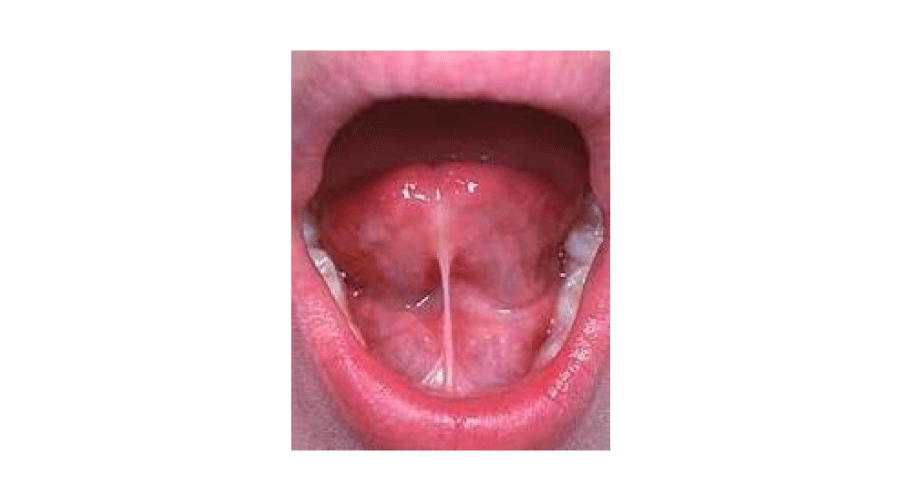
A 21 year old male is encountered to ENT clinics with speech disorder and tongue movement disorder. We found ankyloglossia with thick and short frenulum in our physical examination (Figure 1). The remaining head and neck examination was normal. There is no syndromic child and cleft palate in patient’s history. The diagnosis is based on physical examination and symptoms of the patients.
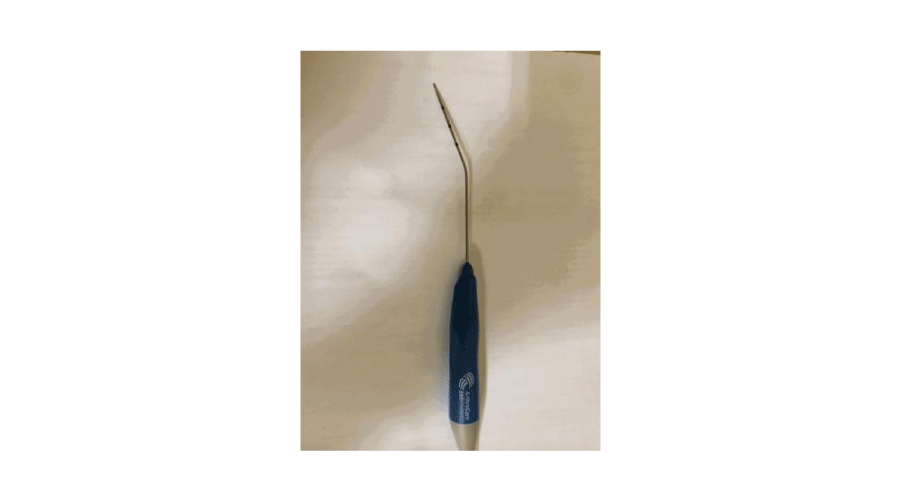
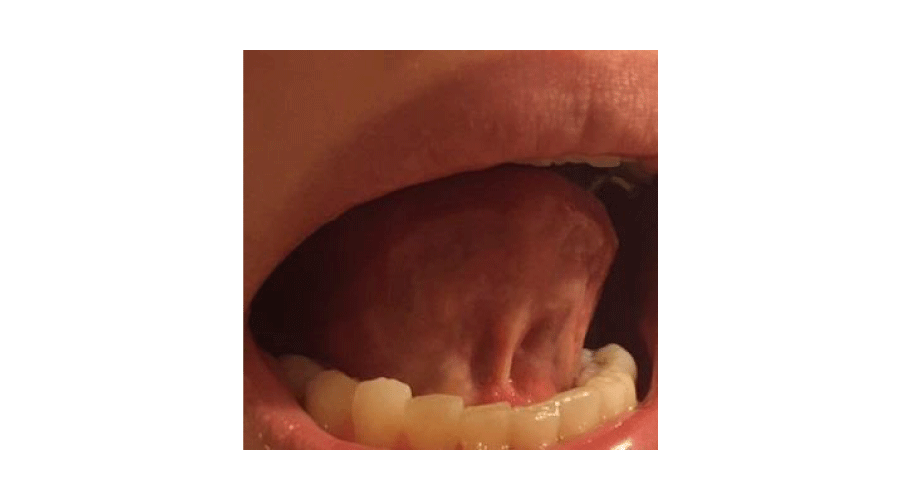
Ankloglosia was excited during coblation assited dissection. We used Artrocare probe of coblation device designed for tonsillectomy surgery (Figure 2). Frenulectomy is performed in both tongue side and gingivobuccal side of the frenulum (Figure 3). The settings of coblator are 5 for coblation and 2 for coagulation. The ankloglosia is dissected to the base of tongue using coblator probe. We left the, remain tissue to secondary wound healing without the using suture techniques. The patient is controlled in the postoperatively 3.day, 7.day, 1. Month and 3. Month. There was no complication and restenosis after surgery. Patient satisfaction is good after surgery.
Discussion
Ankyloglossia is a congenital disorder. There have been reported many classification systems about the disease in the literature [5]. Thick and short lingual frenulum, limited function of tongue and functional disorder of breast-feeding are considered of diagnosis criterias. There is no conclusion about the issue [6]. Prolonged Nipple pain is reported in mothers of ankyloglossia patients in literature [6]. This may lead to social problems as early cessation of breast-feeding.
Pathogenesis of the disease is not clear. Most commonly sporadic cases in otherwise healthy children. Disease can be associated with x-linked cleft palate, van der Voude syndrome and maternal cocaine abuse [7-9]. Connection between mutation of TBX22 gene and ankyloglossia is documented in literature [10].
Many surgical methods are described in the literature in the surgical treatment of ankyloglossia. Frenectomy, frenulectomy and frenuloplasty is described as surgical methods [12,13]. Frenectomy may be chosen in first 6 months of life. Frenuloplasty and frenulectomy can be chosen after 6 month of life time [11]. Cold surgical intervention has disadvantages of prolonged surgical time, bleeding in surgery, risk of damage to lingual nerve and Wharton duct.
Laser surgical intervention is well documented in literature. Different type of lasers are described in ankyloglossia surgery [14-16]. Intraoperative use of laser surgery provides bloodless field of surgery. These surgical method has disadvantages of delayed healing of tissues due to high thermal energy, usage of expensive equipment [16].
Coblation surgery is a technology. Coblation surgery can be used in Tonsillectomy, adenoidectomy, soft palate surgery, inferior turbinate surgery in head and neck surgery [17]. Plasma molecules effects the tissues at low temperatures (40-70 C). Hemostasis is ensured during surgery with minimal damage to neighborhood tissues. This advantage assures reduced risk formation of scar tissue. Teorically this situation may lead to decrease in restenosis. Coblation is cheaper than laser technology and can be applied in many centers with less equipment.
There are many few investigations about the use of coblation in ankyloglossia surgery in literature. We achieved good surgical results in midterm without complication in our study. Further prospective studies are needed about the issue to provide long term results.
- Ballard JL, Auer CE, Khoury JC (2002) Ankyloglossia: Assessment, incidence, and effect of frenuloplasty on the breastfeeding dyad. Pediatrics 110: e63 .
- Heller J, Gabbay J, O’Hara C, Heller M, Bradley JP (2005) Improved ankyloglossia correction with four flap Z frenuloplasty. Ann Plast Surg 54: 623-628 .
- Haytac MC, Ozcelik O (2006) Evaluation of patient perceptions after frenectomy operations: A comparison of carbon dioxide laser and scalpel techniques J Periodontol 77: 1815-1819 .
- Doshi Y, Shah M, Khandge N, Sanghavi A (2010) Advantages of diode laser (940 Nm) over surgical blade in management of ankyloglossia: A case report. J Oral Laser Appl 10: 165-169 .
- Suter VGA, Bornstein MM (2009) Ankyloglossia: Facts and Myths in Diagnosis and Treatment. J Periodontol 80: 1204-1219 .
- Segal LM, Stephenson R, Dawes M, Feldman P (2007) Prevalence, diagnosis, and treatment of ankyloglossia: methodological review. Can Fam Physician 53: 1027-1033 .
- Pauws E, Peskett E, Boissin C, Hoshino A, Mengrelis K, et al. (2013) X-linked CHARGE-like Abruzzo-Erickson syndrome and classic cleft palate with ankyloglossia result from TBX22 splicing mutations. Clin Genet 83: 352-358 .
- Sudhakara Reddy R, Ramesh T, Vijayalakshmi N, Lavanya Reddy R, Swapna LA, et al. (2012) Van der Woude syndrome- a syndromic form of orofacial clefting. J Clin Exp Dent 4: 125-128 .
- Harris EF, Friend GW, Tolley EA (1992) Enhanced prevalence of ankyloglossia with maternal cocaine use Cleft Palate Craniofac J 29: 72-76 .
- Pauws E, Moore GE, Stanier P (2009) A functional haplotype variant in the TBX22 promoter is associated with cleft palate and ankyloglossia. J Med Genet 46: 555-561 .
- Heller J, Gabbay J, O'Hara C, Heller M, Bradley JP (2005) Improved ankyloglossia correction with four-flap Z-frenuloplasty Ann Plast Surg 4: 623-628 .
- Tuli A, Singh A (2010) Monopolar diathermy used for correction of ankyloglossia. J Indian Soc Pedod Prev Dent 28: 130-133 .
- Ramya V, Mani Sundar N, Balaji A (2012) Management of ankloglosia with scarpel and electrosurgery method. Indian Journal of multidisciplinary dentistry 2: 472-475 .
- Aras MH, Göregen M, Güngörmüş M, Akgül HM (2010) Comparison of diode laser and Er:YAG lasers in the treatment of ankyloglossia. Photomed Laser Surg 28: 173-177 .
- Fiorotti RC, Bertolini MM, Nicola JH, Nicola EM (2004) Early lingual frenectomy assisted by CO2 laser helps prevention and treatment of functional alterations caused by ankyloglossia. Int J Orofacial Myology 30: 64-61 .
- Kotlow L (2011) Diagnosis and treatment of ankyloglossia and tied maxillary fraenum in infants using Er:YAG and 1064 diode lasers. Eur Arch Paediatr Dent 12: 106-112 .
- Duarte VM, Liu YF, Shapiro NL (2014) Coblation total tonsillectomy and adenoidectomy versus coblation partial intracapsular tonsillectomy and adenoidectomy in children. Laryngoscope 124: 1959-1964 .



 Save to Mendeley
Article Alerts
Subscribe to our articles alerts and stay tuned.
 This work is licensed under a Creative Commons Attribution 4.0 International License.