Archives of Otolaryngology and Rhinology
Trans Tracheal Approach to the Oesophagus: Case Report
1Department of Otolaryngology Head and Neck Surgery, Princess Alexandra Hospital, Brisbane, Australia
2Department of Upper Gastrointestinal Surgery, Princess Alexandra Hospital, Brisbane, Australia
3Department of Plastic and Reconstructive Surgery, Princess Alexandra Hospital, Brisbane, Australia
Author and article information
Cite this as
Lynch A, Perry C, Smithers BM, Gundelach R, Rowe D (2016) Trans Tracheal Approach to the Oesophagus: Case Report. Arch Otolaryngol Rhinold. 2016; 2(2): 77-78. Available from: 10.17352/2455-1759.000030
Copyright License
© 2016 Lynch A, et al. This is an open-access article distributed under the terms of the Creative Commons Attribution License, which permits unrestricted use, distribution, and reproduction in any medium, provided the original author and source are credited.Hypopharyngeal squamous cell carcinoma (SCC) is a rare form of malignancy and treatment approach is most commonly with chemo-radiotherapy or total pharyngolaryngoesophagectomy. We report a case of hypopharyngeal SCC managed with local resection and larynx preservation in a 77-year-old-woman. Total pharyngolaryngoesophagectomy renders patients with an alteration in both voice and ability to swallow hence carrying signifi cant post-operative morbidity. We review the literature for similar larynx-preserving operations and illustrate a novel approach to the management of this rare malignancy.
Case
A 77-year-old woman was diagnosed with a localized squamous cell carcinoma (SCC) inferior to the cricopharyngeus. She was considered unfit for chemotherapy and was treated with definitive radiotherapy alone (56gy in 28 fractions). Surveillance endoscopy at three months was normal but at six months there was evidence of recurrent disease with a 2cm nodule below the cricipharyngeus region, confirmed as SCC on pathology. The rest of the oesophagus was normal. FDG PET/CT revealed a localized avid lesion as the only pathology. Panendoscopy and rigid bronchoscopy demonstrated extrinsic protrusion into the membranous tracheal wall with intact mucosa and no other mucosal abnormality.
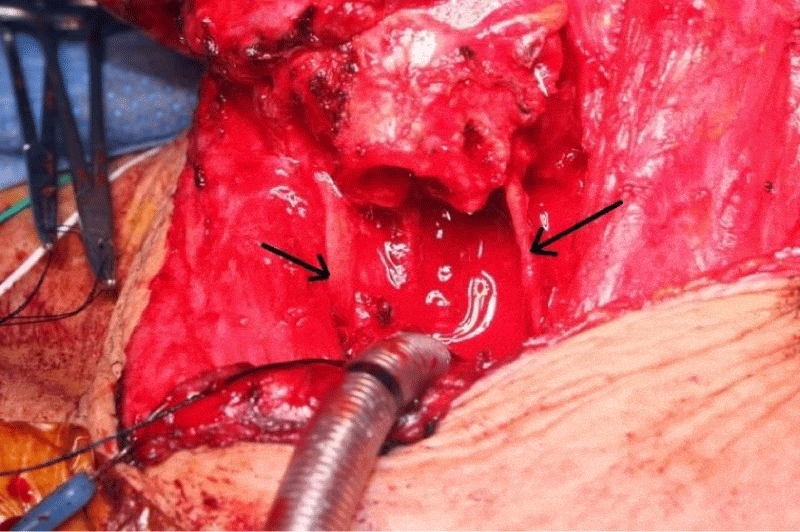
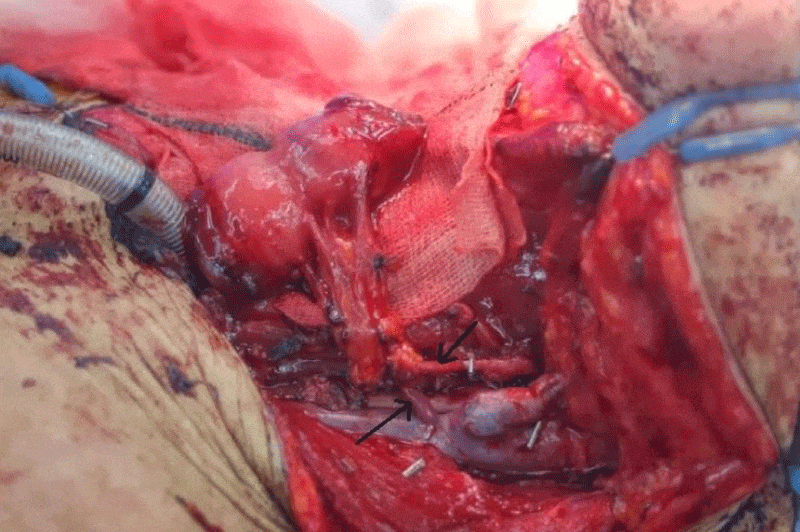
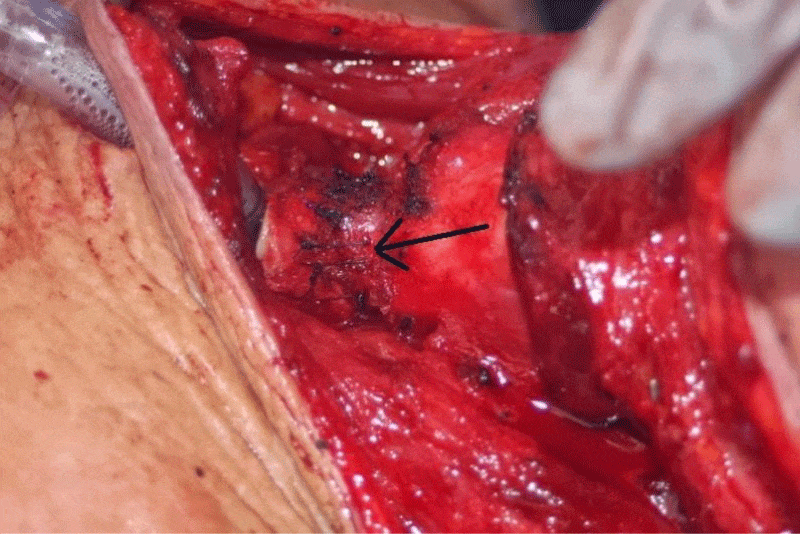
The patient wished to avoid permanent tracheostomy. She accepted the option of a cervical oesophagectomy with jejunal interposition if it was evident a normal margin from the cancer could be achieved. At operation the cancer did not involve the trachea. The thyroid isthmus was divided and the individual thyroid lobes mobilized and laterally pedicled on their blood supply. The recurrent laryngeal nerves on each side were preserved, kept moist, and continually monitored using a NIM (Nerve Integrity Monitor).Complete access to the cervical oesophagus was obtained by tracheal transection between the first and second rings opening the trachea like a sliding double door (Figure 1). Proximal resection was through the level of the inferior constrictor 1cm beyond the tumour with a similar margin distally through the oesophagus. Frozen section reported no evidence of carcinoma at either margin. A left level II – IV neck dissection was performed. A jejunal segment was harvested via laparotomy and a feeding jejunostomy constructed. The jejunum was revasularized with microvascular anastomosis to the facial artery and internal jugular vein. Anastomosis to the lower pharynx and the oesophagus was performed with interrupted absorbable sutures (Figure 2). The trachea was closed with interrupted sutures, and tracheostomy created between the 4th and 5th tracheal rings (Figure 3).
- Sun F, Li X, Lei D, Jin T, Liu D, et al. (2014) Surgical management of cervical esophageal carcinoma with larynx preservation and reconstruction Int J Clin Exp Med 7: 2771-2778. Link: https://goo.gl/fYZy52
- Link: https://goo.gl/l4xQdM
- Miyata H, Yamasaki M, Takahashi T, Kurokawa Y, Nakajima K, et al. (2013) Larynx-preserving limited resection and free jejunal graft for carcinoma of the cervical esophagus. World J Surg 37: 551-557. Link: https://goo.gl/GMWF1h
- Giovanni de Manzoni AZ, Simone Giacopuzzi (2012) Controversial Issues in Esophageal Cancer: Surgical Approach and Lymphadenectomy. In: Manzoni Gd, editor. Treatment of Esophageal and Hypopharingeal Squamous Cell Carcinoma: Springer Milan; 139-159. Link: https://goo.gl/0hcYyA
- Nunobe S, Igaki H, Tachimori Y, Kato H (2007) A successful case of larynx preservation by temporary transection of the trachea for a relapse tumor in the cervical esophagus after complete response to chemoradiotherapy: Report of a case. Esophagus 4: 169-171. Link: https://goo.gl/90xu75
- Shirakawa Y, Naomoto Y, Noma K, Ono R, Nobuhisa T, et al. (2004) Free jejunal graft for hypopharyngeal and esophageal reconstruction. Langenbecks Arch Surg 389: 387-390. Link: https://goo.gl/G2Yz6O
- Kato H, Ebihara S (1992) Temporary transection of the trachea in cervical esophagectomy. Eur J Surg Oncol 18: 335-339. Link: https://goo.gl/zr8Y5b
- Zhao D, Gao X, Guan L, Su W, Gao J, et al. (209) Free jejunal graft for reconstruction of defects in the hypopharynx and cervical esophagus following the cancer resections. J Gastrointest Surg 13: 1368-1372. Link: https://goo.gl/Hk2pE0
- Ott K, Lordick F, Molls M, Bartels H, Biemer E, et al. (2009) Limited resection and free jejunal graft interposition for squamous cell carcinoma of the cervical oesophagus. Br J Surg 96: 258-266. Link: https://goo.gl/2B8ZGm



 Save to Mendeley
Article Alerts
Subscribe to our articles alerts and stay tuned.
 This work is licensed under a Creative Commons Attribution 4.0 International License.